
I’m fifty. I collect cars and keep things I shouldn’t. I am not a software engineer.
The spec for this app had been compiling in my head for decades. Thirty-five years of buying and selling things, knowing exactly what was broken about it, waiting for the right tool to make it real. Every platform I’ve ever sold something on has the same problem. You list it, someone messages “is this still available?”, you say yes, they disappear. Someone else lowballs you. A third person wants to come Tuesday, then Thursday, then ghosts. You’re managing a sales floor from your couch and nobody’s paying you for it.
When AI tools got good enough to build with, I recognized the moment. This wasn’t a new idea. It was finally having the means. I’ve been looking for one big swing my whole life. There’s a $500 billion global resale market. I looked at it, looked at what I could build, and decided this was it.
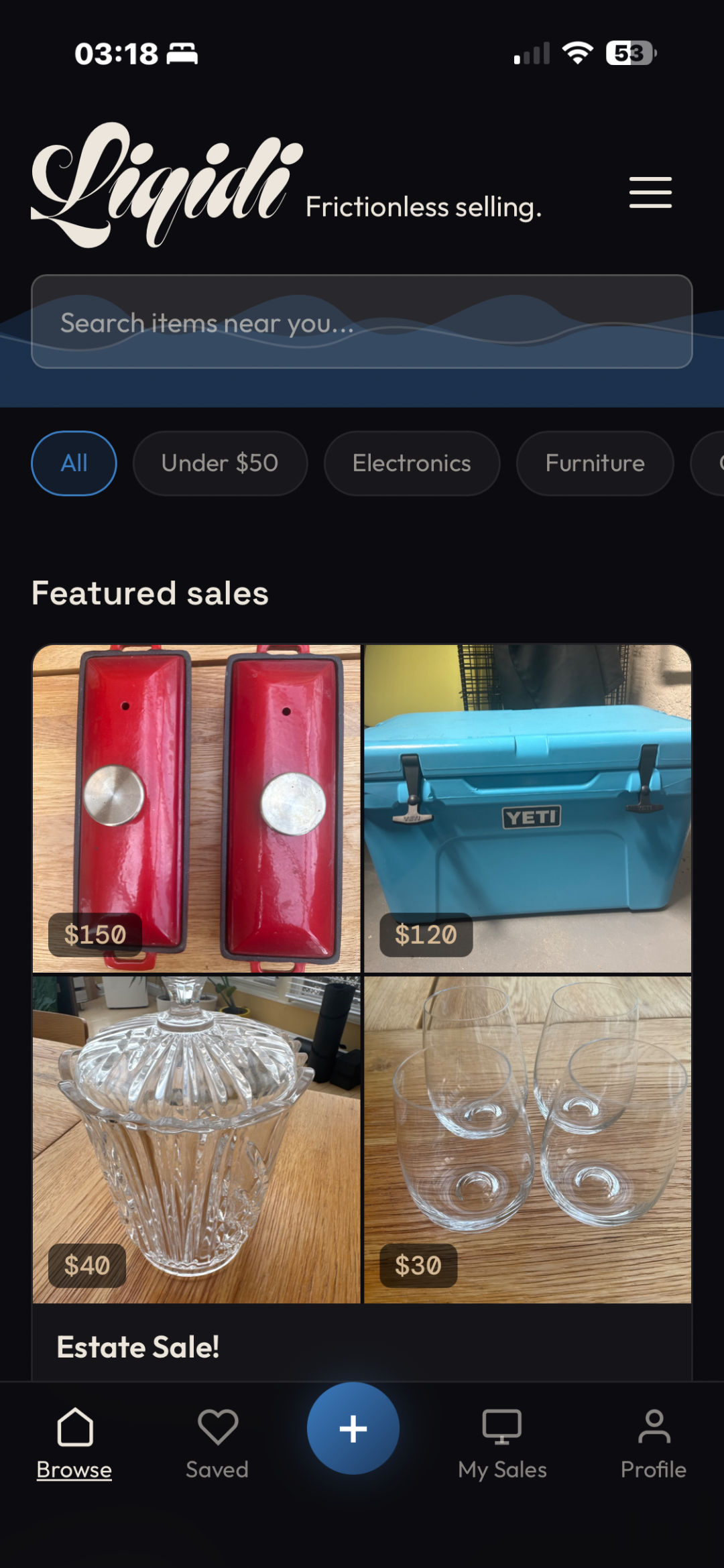
Liqidi is a secondhand marketplace where AI does the heavy lifting. You photograph what you’re selling. The platform identifies it, writes the description, suggests a price. Buyers submit what I call an Atomic Offer — a price and a pickup time, locked together. No negotiation loop. No messages that go nowhere. You confirm, they show up, it’s done.
I built the whole thing with AI. Directed it, argued with it, watched it fix the same bug four times in the wrong file. My first paying user hit a broken checkout. My first non-founder user couldn’t find his way back to my listing. I migrated the entire production server because my cPanel password got locked and it was faster to move everything than wait for support. That’s the actual texture of building something. You ship it, it breaks, you fix it, something else breaks.
No urgency tricks. No ads. No dark patterns. Flat fee. Long-term, the structure becomes a public purpose trust. Liqidi eventually belongs to its users, not to investors chasing exits. That’s not idealism. That’s the whole point.
I come from generational poverty. I grew up weighing every choice against the wallet. That calculus never stopped — it just got more sophisticated. I don’t want my kids running the same math. I want a family trust. Not wealth for the sake of it, but enough that work becomes something you choose, not something you survive. The 15-20 hour days make sense when you understand that. They’re not hustle culture. They’re what it looks like when the shot is finally in front of you and you know exactly what missing it costs.
The contradiction isn’t lost on me — building something to make money so money stops mattering. But the problem was never money itself. It was money as a permanent variable in every decision. I’m trying to make it a constant so it stops being a factor. That’s why Liqidi ends up in a trust. Not a business strategy. A personal philosophy made structural.
It’s live at liqidi.us. There’s still a lot to build. There’s an academic paper in development and a book about the build itself, both running alongside the product work.
My wife said she liked it. She doesn’t say that lightly.
Still building.
Comments